
We offer advanced strategic marketing support to help you understand your audience, craft winning strategies, and achieve real business growth. Our team ensures every campaign aligns with your goals and delivers clear ROI.

Reach your audience with content that informs, inspires, and converts. From blogs and social posts to videos and ad copy, we create content that attracts, engages, and grows your brand.

We deliver innovative solutions that solve real problems, boost efficiency, and help your brand stay ahead in a fast-changing digital world.
1
We craft targeted digital marketing strategies that connect your business with the right partners, driving lead generation and long-term professional relationships.
2
Our creative campaigns engage consumers directly, boosting brand awareness and sales by delivering personalized experiences that resonate with your audience.
3
From SEO to PPC and social media, we optimize your online store to increase traffic, improve conversions, and maximize your revenue.
4
We help educational institutions attract students and build their reputation through tailored content marketing, social media, and digital outreach.
5
Our scalable digital solutions empower large organizations to streamline marketing efforts, enhance brand visibility, and achieve measurable growth.
6
We provide agile, cost-effective marketing strategies designed to build your brand from the ground up and accelerate your market entry.
Our approach is never one-size-fits-all. We conduct thorough analysis and develop customized digital marketing strategies aligned with your unique business goals..
From SEO, social media marketing, and PPC advertising to content marketing, web development, branding, and influencer campaigns, we offer everything you need under one roof.
Our team of experienced professionals stays updated with the latest trends and technologies, ensuring your business benefits from cutting-edge strategies and tools.
Your business objectives are our top priority. We listen, adapt, and provide personalized service, building long-term partnerships based on trust and measurable success.
We offer cost-effective packages suitable for startups, SMEs, and large enterprises, ensuring you get maximum ROI regardless of your business size.
We keep you informed at every step with clear, regular updates and transparent reporting, so you always know the impact of your investment.
The analytics and reporting services from Clickthrown Digital Gallery have empowered us with valuable insights. The data-driven approach has allowed us to make informed decisions, optimize our marketing strategies, and measure the impact of our campaigns.
Glen India Pvt Ltd
Working with Clickthrown Digital Gallery has been a game-changer for our online presence. Their SEO expertise skyrocketed our website to the top of search engine results, bringing in targeted traffic and boosting our conversions.
Managing Director, Coreminds
The analytics and reporting services from Clickthrown Digital Gallery have empowered us with valuable insights. The data-driven approach has allowed us to make informed decisions, optimize our marketing strategies, and measure the impact of our campaigns.
Glen India Pvt Ltd
Working with Clickthrown Digital Gallery has been a game-changer for our online presence. Their SEO expertise skyrocketed our website to the top of search engine results, bringing in targeted traffic and boosting our conversions.
Managing Director, Coreminds
We begin by understanding your business, target audience, and goals. This helps us identify challenges and opportunities in your current digital presence.
Next, we conduct in-depth research on your industry, competitors, and market trends to gather valuable insights that guide our strategy.
With data in hand, we develop a clear action plan tailored to your objectives, defining timelines, deliverables, and KPIs for success.
Our creative team brings ideas to life with compelling visuals, user-friendly layouts, and designs that reflect your brand identity.
We fine-tune every aspect—content, SEO, and performance—to ensure maximum visibility, engagement, and conversion.
Before going live, we run multiple tests to check functionality, responsiveness, and performance across all devices and platforms.
We deliver measurable results and detailed reports, showing the impact of our efforts and identifying opportunities for continuous improvement.
In 2021, the amount spent globally on digital advertising reached a massive sum of $455.3 billion. According to Statista, this is expected to reach $646 Billion by 2024. As a result, new forms of online marketing are coming into existence with every passing day. Among these, some notable ones are social media advertising, affiliate marketing, email marketing, and performance marketing.
In this blog, we will be taking a closer look at performance marketing, its core concepts, how it works, and why you should use it.
What is Performance Marketing?
Performance marketing is a digital marketing approach that focuses on measurable outcomes such as clicks, conversions, or sales rather than just brand awareness. It is data-driven and makes use of Key Performance Indicators (KPIs) for evaluating success. It involves tracking and analyzing various metrics such as conversion rates, click-through rates, and return on investment(ROI).
Performance marketing is driven by ROI since all actions can be tracked and measured against key performance indicators (KPIs). Be it the number of clicks, page views, or sales, these key metrics are important in measuring and improving performance.
Below are some of the most commonly used metrics and KPIs for you to get a better understanding of performance marketing pricing.
This is the amount retailers or merchants pay when consumers complete a desired action, such as a sale, a click, or completing a form.
In e-commerce, this is a very common payment model for merchants to set up.
A “lead” can either be a completed form registration or signup involving customer information — such as a customer’s name, email address, or phone number — which can then be used by the merchant to follow up with the customer and drive sales.
This is the price paid by a retailer to an affiliate for any ad clicks they refer to a desired landing page.
In this payment model, the “X” can be anything that the merchant defines as the desired action outside of a lead, click, or sale.
Downloads, upsells within apps, and rewards program sign-ups are some examples of these.
The purpose of this metric is to estimate the "lifetime value" of a customer throughout their relationship with the retailer. Based on a customer's behavior and actions with the brand, LTV calculates how much the customer will spend.
Well-defined Goals and Objectives
Identifying the Target Audience
Choosing the Right Channels
Analysis of Performance
Budgeting and ROI Analysis
Performance marketing includes several different types of marketing. The following is a small overview of different types of performance marketing and how each can benefit your e-commerce business.
Any digital marketing strategy that is connected to the advertiser and pays out when the desired action is completed is known as affiliate marketing. This may include collaborating with discount, loyalty, review, and incentive websites, or working with an influencer, YouTuber, or blogger.
Unlike display ads or banner ads, this type of paid media does not appear to be an advertisement.
Native ads tend to fit “natively” on the page/site they’re placed on — such as news or social sites and can be fed dynamically based on each user viewing the content.
The most common payment models for native advertising are CPM (pay per impression) and CPC (cost per click).
Sponsored content is a type of native advertising and content marketing in which a dedicated article or video is included on a website that distributes similar content. This way, the sponsored content blends in with the rest of the content while yet displaying some indicator that it is sponsored.
Compensation can take the form of a free product or experience, as well as a CPA-, CPM-, or CPC-based payout.
This type of performance marketing utilizes social media networks to increase traffic and brand recognition, such as digital content displayed on Facebook, LinkedIn, or Instagram.
Merchants can reach potential customers by using a variety of ad types and targeting options while evaluating KPIs like engagement, clickthrough rate (CTR), CCP, and ROI.
Paid search marketing involves an advertiser paying for clicks to sponsored ads on search engines such as Google Ads, Bing, and Yahoo. Or, less commonly, an advertiser may pay each time their ad is displayed (CPM).
Search Engine Optimization (SEO)
The opposite of paid search marketing, organic search uses unpaid methods such as search engine optimization (SEO) and relies on the search engine’s algorithm to rank at the top.
What are Some Performance Marketing Tips to be Successful?
Having covered the basics, let's jump into our top tips for performance marketing success.
1. Focus on a good landing page and offer
In performance marketing, having a good landing page is crucial. If your landing page quality is low, it can deter visitors from converting, and a bad offer can prevent them from clicking through.
As an advertiser, make sure you have an appealing offer for your affiliates, and keep testing your site for any potential problems a visitor might run into.
Evaluate the complete user experience, from the landing page to the shopping cart. Test links and offers regularly, and change any underperforming content and landing pages.
2. A/B test and optimize for revenue-driving KPIs
Testing and measuring are two essential steps for ensuring that a digital marketing strategy is working.
In the case of performance marketing, try different techniques and strategies for optimization of click-through rates, conversion rates, AOVs, and traffic by doing A/B testing to get a clear picture of what’s working and what’s not.
3. Choose your traffic sources carefully
Quality matters more than quantity. Therefore focus on making sure your traffic is coming from reputable sources. When untrustworthy sources are advertising you, consumers may think twice about trusting you as a brand.
So instead of generating lots of low-quality traffic, partner with affiliates that will drive meaningful traffic to your site.
4. Track and monitor as much as you can
Attribution, mobile vs. desktop, bounce rates, etc. are some factors that provide important campaign data points for you to get better insights into what’s working and what’s not.
Tracking and monitoring your gains and losses is crucial in getting the most out of your performance marketing campaign.
Performance marketing holds great potential for business owners seeking to engage and convert new customers at a large scale and a reduced cost. There's always room to grow and improve, no matter where you and your brand are in the performance marketing space.
Learn which strategies are effective for you and how to satisfy the demands of your affiliates as well as your brand. As soon as you have determined your precise objectives, get started with building those connections.
Quality content lies at the heart of every successful digital marketing strategy. Whether it's blog posts, videos, or infographics, valuable and relevant content not only attracts but also retains the attention of your audience. Develop a content strategy that aligns with your brand voice and speaks to the needs and interests of your target demographic.
One of the advantages of digital marketing is the wealth of data it provides. Dive into the analytics to gain insights into the performance of your campaigns. By leveraging data-driven decision-making, you can continuously refine and optimize your strategies for maximum impact.The digital landscape is in a constant state of flux, with new technologies and trends emerging regularly. Stay ahead of the curve by keeping abreast of the latest developments in the digital marketing sphere. From artificial intelligence and chatbots to immersive technologies, explore how these trends can be integrated into your marketing arsenal.
Develop a content strategy that aligns with your brand voice and speaks to the needs and interests of your target demographic.By leveraging data-driven decision-making, you can continuously refine and optimize your strategies for maximum impact.By understanding the intricacies of the digital landscape and adopting a comprehensive strategy, your business can unlock the full potential of digital marketing to reach, engage, and convert your target audience. As the digital realm continues to evolve, a proactive and adaptive approach will ensure that your business remains at the forefront of the digital marketing revolution.
In today’s fast-paced digital world, having a strong online presence is essential for business success. Digital marketing offers powerful tools to connect with your target audience, build brand awareness, and drive conversions. However, to truly stand out in a crowded market, businesses need to adopt effective strategies that not only capture attention but also foster long-term customer loyalty. Let's take a look at the key strategies that businesses can implement to achieve long-term success in digital marketing.
Search engine optimization (SEO) is the cornerstone of any successful digital marketing campaign. By optimizing your website content and structure, you can increase your visibility on search engines like Google. Higher visibility translates to more organic traffic, which means more potential customers discovering your brand. A comprehensive SEO strategy involves keyword research, on-page optimization, backlink building, and ensuring your website is mobile-friendly. Investing in SEO ensures that your website remains discoverable to those who need your services most.
While SEO builds long-term growth, Pay Per Click (PPC) advertising provides a quick boost to your brand’s visibility. With PPC campaigns, you can target specific keywords, demographics, and locations to ensure your ads are reaching the right audience. PPC also allows for detailed tracking, so you can see what’s working and continuously refine your campaigns for better results. It’s a great way to get immediate traffic while working on your SEO strategy.
Social media platforms like Facebook, Instagram, LinkedIn, and Twitter provide an excellent opportunity to connect with your audience in real time. Consistent social media marketing builds relationships, encourages customer interaction, and helps humanize your brand. Sharing valuable content, responding to customer queries, and running ads on social media platforms ensures that your business stays top-of-mind. Whether you’re running promotions, posting updates, or simply engaging with customers, social media is a vital part of your digital marketing strategy.
Content is king, and for good reason. Effective content marketing allows you to provide value to your audience while showcasing your expertise. Blog posts, videos, infographics, case studies, and white papers all serve to inform, engage, and convert potential customers. By creating high-quality content that resonates with your target audience, you build trust and credibility, which leads to higher conversion rates and a stronger relationship with your customers.
One of the key advantages of digital marketing is the wealth of data it provides. Analytics tools track everything from website traffic to customer behavior, allowing you to make informed decisions. By analyzing campaign performance, you can understand what works and what doesn’t. This data-driven approach ensures you’re constantly refining your strategies for the best possible outcomes. At Clickthrown Digital Gallery, we use analytics to guide our decisions and optimize our clients’ campaigns for maximum impact.
Email marketing remains one of the most effective tools for driving conversions. Through personalized email campaigns, you can nurture leads, deliver valuable content, and promote products or services directly to your audience. Whether it’s through newsletters, promotional emails, or automated drip campaigns, email marketing allows you to stay connected with your audience and increase engagement.
To succeed in today’s competitive market, businesses need a well-rounded digital marketing strategy that incorporates SEO, PPC, content marketing, social media, and data analytics. By understanding your audience and continuously optimizing your approach, you can stay ahead of trends, drive more traffic, and convert that traffic into loyal customers. At Clickthrown Digital Gallery, we specialize in crafting customized digital marketing strategies designed to help you grow and thrive in the digital space. Let us help you unlock the full potential of your online presence!
Digital Marketing is developing more quickly than ever in the AI-driven world of today. AI tools like ChatGPT and ShellGPT are becoming indispensable for performance marketers, helping them with anything from writing effective ad copy to automating backend processes. Although these technologies increase efficiency and return on investment, some, like FraudGPT and WormGPT, are being used maliciously and represent serious risks to campaigns and brand security.
Let's examine what these AI models do, how they benefit, and what marketers should be aware of.
OpenAI created ChatGPT, an advanced AI language model that can comprehend and produce writing that sounds human. It's a revolutionary tool for marketers that speeds up campaign operations, improves consumer interaction, and simplifies content development. ChatGPT helps you operate more efficiently, creatively, and ethically while producing results that are safe for your brand, whether you're writing ad text, creating chatbot scripts, or optimizing SEO content.
ChatGPT features built-in safety filters to prevent abuse, allowing you to concentrate on performance and creativity without going against moral principles.
Natural language is translated into shell commands by ShellGPT, an AI-powered command-line assistant. It enables developers and tech-savvy marketers to manage server-side operations, automate backend tasks, and simplify deployments without requiring them to commit complicated code to memory.
ShellGPT, for instance, makes it easier and faster to deliver website upgrades for a high-traffic campaign, manage logs, and erase cache without requiring you to commit instructions to memory.
WormGPT is an unethical AI model designed for cybercriminal activities. Unlike ChatGPT or ShellGPT, WormGPT has no content moderation, making it a preferred tool for generating phishing emails, malicious scripts, and social engineering attacks. It’s often sold on dark web forums as an “uncensored” alternative to ChatGPT.
Another dark-web AI technology designed especially for fraudulent activities is called FraudGPT. It is promoted to con artists who want to fabricate identities, replicate company profiles, or use non-human visitors to falsify ad stats.
Use AI to develop, but stay alert. When used properly, artificial intelligence (AI) can be a very useful tool in your marketing toolbox. Use ChatGPT and ShellGPT to improve your performance, workflow, and content. Steer clear of or report tools like WormGPT and FraudGPT that are intended to exploit, defraud, or deceive.
Google frequently updates its algorithm. Some changes are subtle, while others can impact your website’s visibility. The June 2025 Core Algorithm Update is one of the more impactful ones, especially for content-driven sites.
Well, What’s New in the June 2025 Update? This update reinforces Google’s long-standing focus on E-E-A-T (Experience, Expertise, Authoritativeness, and Trustworthiness). It brings stricter penalties for low-quality content, particularly that generated by AI without proper editing or refinement.
In short:
If your website relies heavily on unrefined AI-generated content, you may already be seeing a drop in rankings. The days of pumping out mass content with little value are quickly fading. Google is rewarding well-written, human-reviewed, and genuinely helpful content that demonstrates real-world experience and expertise. If you haven’t yet adopted E-E-A-T principles in your content strategy, it’s time to start or risk falling behind.
Let’s take a look at how E-E-A-T and AI combine to affect Google rankings in 2025.
E-E-A-T isn’t new, but it’s more important than ever. E-E-A-T stands for experience, expertise, authoritativeness, and trust. It is a set of quality guidelines that Google’s search engines use to assess content. This is particularly important for topics that can impact a person’s well-being, such as health, finance, and safety. E-E-A-T ensures that search results prioritize trustworthy and useful information in creating content for these YMYL (Your Money, Your Life).
In 2025, Google wants to ensure that users get accurate, relevant, and trustworthy information from real experts. As a result, if you are a content writer or an SEO professional, now is the time to:
A Big NO to Purely AI-Generated Content!
Let’s be clear, simply publishing AI-generated content is no longer enough to rank on Google.
With tools like ChatGPT, Jasper, and others becoming widely accessible, anyone can spin up a blog post in minutes. Google knows this, and its June 2025 Core Update is cracking down hard on generic, low-quality AI content. If you're just copying and pasting AI drafts without refinement, don’t expect to see results.
Today, AI can be used to generate perfectly structured blog posts, product descriptions, and SEO-rich pages. However, what it can’t do is live a human experience, travel to Egypt, survive a car crash, raise a child with autism, or run a bakery through a recession. Google has caught on.
Sites that rely solely on generic or obviously AI-written content are seeing declining visibility. Those that embed personal stories, original insight, and firsthand evidence are rising in the ranks.
However, if you’re using AI strategically, as a foundation, not a final product, you’re still in the game. When AI-generated content is edited for clarity, infused with real expertise, and aligned with E‑E‑A‑T (Experience, Expertise, Authoritativeness, Trustworthiness) principles, it can still rank and, of course, rank well!
So, What Should You Do?
Remember, if your content doesn’t feel real, useful, or trustworthy to users, Google won’t trust it either.
Google Workspace just got even smarter! In an exciting update, Google has added a brand-new app to its productivity suite: Google Vids. Positioned alongside your favorite tools like Docs, Sheets, Slides, and Meet, Google Vids is designed to make video creation as easy as writing a document or building a slide deck.
Google Vids is an AI-driven video creation and collaboration tool seamlessly integrated into Google Workspace. With Vids, users can easily create professional-looking videos for work presentations, training, marketing, or internal communications — no video editing expertise required!
The tool helps users plan, draft, and produce videos with the help of AI. From writing scripts to generating storyboards and adding voiceovers, Vids makes the entire process collaborative and intuitive, just like working on Docs or Slides with your team.
Google Vids is perfect for:
Google Vids is conveniently accessible right from your Google Workspace app launcher. Look for the purple play icon labeled Vids — it’s now as accessible as Docs, Sheets, and Slides!
With Google Vids, video creation becomes a core part of the Google Workspace ecosystem. It’s a game-changer for organizations that want to tell their stories through video but don’t have the time or resources for complex editing software.
This update demonstrates how Google continues to integrate AI into everyday work, empowering teams to create smarter, faster, and more collaborative solutions.
In the dynamic world of Pay-Per-Click (PPC) advertising, structuring your campaigns effectively is essential for maximising Return on Investment (ROI). A well-organised PPC structure can help you reach your target audience more efficiently, improve your ad relevance, and ultimately drive more conversions. A key element of PPC campaign strategy is mirroring your business model. In this article, we will explain why it is important to mirror your business model in your PPC structure, as well as provide practical tips on how to do it effectively.
Before diving into the importance of mirroring your business model, it’s essential to understand the basics of PPC structure. A typical PPC account structure includes:
Mirroring your business model in your PPC structure offers several benefits, the key benefits including:
By mirroring your organizational structure in your PPC setup, you're able to create highly relevant and targeted ads. When campaigns and ad groups mirror your product categories, services, or customer segments. By that you can create ad copy that directly meets your audience’s needs and search intent. This precision ensures that users encounter ads that are incredibly pertinent to their queries, increasing the likelihood of engagement and clicks. For example, if you sell both running shoes and hiking boots, having set up ad groups for each product allows you to develop specific ads. For each that encompass their specific benefits compared to a generic footwear ad.
Aligning your PPC structure with your business model provides a clearer framework for optimising your advertising budget. By breaking your campaigns and ad groups according to your business's core offerings, you gain granular insight into the performance of each area. This makes you to strategically allocate your budget, directing more funds towards high-performing products or services that yield the best return on investment. For example, if "premium consulting services" generate higher-value leads than "basic support packages," you can readjust your budget to prioritise the more profitable segment, maximising ad spend efficiency.
A PPC structure that mirrors your business model significantly simplifies the process of tracking performance and generating insightful reports. When your campaigns and ad groups match your business's organization, you will find it easier to track metrics for specific product lines, services, or types of customers. By focusing on your business model rather than broad segments, you can quickly spot trends, identify improvements, and make smarter, data-driven decisions. You are no longer trying to analyze partially related data. You can go directly to information and performance reports for the specific parts of the business where you need to make tactical decisions. This clear association can make it easier to make quick changes for optimization.
To optimise your PPC structure, you can use these PPC structure best practices:
When structuring your PPC campaigns, consider the following steps to optimise performance and drive better results for your business growth.
To gain the most out of Google PPC advertising, consider the following tips:
Mirroring your business model in your PPC campaign strategy is essential for enhancing ROI and driving conversions. By understanding PPC structure, following best practices, and leveraging Google PPC advertising features, you can create effective campaigns that resonate with your target audience.
At Clickthrown, we specialise in helping businesses optimise their PPC campaigns and drive more conversions. With us, you can also start maximising your ROI and achieving your business goals. Let's work together to take your business to the next level to discover the power of effective PPC advertising!
Ever feel like your Performance Max campaigns are delivering results, but it’s unclear which parts of Google’s network are doing the work? Well, get ready to flash the light on that hidden mystery! Google has listened to your calls for more clarity, and the answer is here: Performance Max Channel Reporting.
This isn't just another report; it's a game-changer for understanding how your ads truly perform across the Google ad channels, such as Search, YouTube, Display, Gmail, Discover, and Maps. Join us to explore together how to access, interpret, and leverage these powerful new insights to make ideal, more strategic decisions for your campaigns.
Google Ads Performance Max Channel Reporting is a dedicated feature designed to unwrap the cover on how your Performance Max campaigns are driving results across Google's diverse channels. Performance Max is an aim-based campaign type that uses Google AI and Smart Bidding to find your highest-value customers from all of Google's inventory. Earlier, advertisers couldn’t see which channels were driving most of their conversions.
This new reporting addresses that gap, providing detailed metrics like impressions, clicks, conversions, conversion value, and cost, broken down by individual channel. You can consider it a clear roadmap that shows the journey your customers take and where Google Performance Max ads show their biggest impact.
Accessing these key insights is easy. Here’s a quick guide to find your way to reach:
Once you're in, you'll explore information presented in three key components: a Google Performance Max summary overview, a channel-to-goals visualisation, and a customizable channel distribution table. There's also a helpful status column and diagnostics feature to clear any issues. Each element is designed to give you a clearer picture of your campaign's growth and performance on different channels.
The new reporting isn't just about data; it's about insights that tell a story. Here's what each section reveals:
The exact power of this reporting lies in its ability to drive smarter optimisation. Here's the step-by-step process of how you can improve these insights:
It's essential to remember that Performance Max optimises across all channels using marginal ROI optimisation. This means focusing solely on individual channel CPA or ROAS might not tell the full story. Users often interact with multiple channels on their path to conversion, making a holistic, cross-channel view essential for understanding how your campaigns drive overall results.
Google recommends prioritising your overall goals and audiences over individual channel performance when evaluating effectiveness. In fact, advertisers using cross-channel bidding have frequently observed significant ROI increases, often exceeding 20%.
The Benefits for Every Advertiser
The introduction of Performance Max Channel Reporting is a significant win for marketers. Partnering with a digital marketing agency like Clickthrown can help you get the clicks that matter and unlock the full potential of your campaigns. Here’s what you gain:
Performance Max Channel Reporting is more than a feature; it's a turning point for transparency and control in Google Ads. By working hard with these insights, advertisers are not only better able to comprehend ad performance on Google's enormous properties but also make optimisation decisions that actually deliver.
Regularly checking these reports is key to tracking trends, staying ahead of problems, and fine-tuning your approach. As the Google Ads environment keeps changing, it is ultimately making you wiser and quicker regarding your marketing.
As Google continues to evolve its search technology, new data from BrightEdge reveals a trending insight: Google's AI Overviews now overlap with traditional organic search results by 54%. This means that just over half of the web pages cited by Google's AI-powered Overviews are the same as the ones ranking organically, a significant increase since the feature's launch. Understanding this overlap and its implications is important for SEO professionals and content creators aiming to thrive in the modern search landscape.
So, in this piece of writing, let us delve into the implications of this overlap for SEO professionals and publishers. We will look at the underlying procedures and nuances that are specific to each vertical, as well as provide practical guidance to help you maximise your plans for 2026 and the coming years.
Google's AI Overviews is a search optimisation powered by the FastSearch algorithm, which uses deep-learning models to provide summarised citations from relevant web pages. Unlike traditional organic search rankings that depend on classic ranking signals such as backlinks and page authority, FastSearch focuses on semantic matching and user behaviour signals captured from click and query data. This helps the AI to pick pages that best match the type of content users prefer to see for a given query.
BrightEdge's research shows that 54% of the citations in Google’s AI Overviews are also found in the organic search results. In contrast, 46% of AI Overview citations are unique and do not appear in organic rankings. This suggests that Google's AI is expanding search results by including additional sources it considers relevant based on user behaviour and content quality, widening the scope beyond regular SEO rankings.
The extent of overlap changes across different content types. Below are the differences according to the industries:
Staying ahead with this AI Search, both SEOs and publishers should implement a strategic three-step approach, which includes:
Let us have an in-depth understanding of each step:
This step is to measure the percentage of your content that shows up in both AI Overviews and conventional organic search results. It helps to benchmark your performance against the industry average of 54%, providing clarity on your current standing in the AI-enhanced search landscape
This key step requires tailoring your content and SEO strategies based on your specific overlap profile and the user's search intent.
This final step emphasises the importance of ongoing attention. Regularly check the changes in your overlap percentage and observe industry trends, such as the overall growth in AIO-organic overlap. By staying informed about these shifts, SEOs and publishers can easily adapt to these strategies to maintain effectiveness in the dynamic AI-powered search environment.
Google's AI Overviews have increased their industry-wide overlap by 22%, making them an increasingly important component of the search ecosystem. Understanding how AI interprets and surfaces content is the key focus for success in 2026 and beyond. Even though traditional SEO is still fundamental, publishers can guarantee visibility in both organic and AI-powered search results by aligning user intent and concentrating on quality.
To maximise content reach and engagement, this new environment encourages all digital marketers to closely monitor search trends and quickly adjust to Google's continuous innovations.
In order to support SEO strategies that are in line with the direction of search, this overview offers a new and practical viewpoint on Google AI Overviews. With Clicthrown’s strategic guidance, you can align with these changes and achieve long-term visibility.
1.What is the current overlap between Google's AI Overviews (AIO) and traditional organic search results?
According to new research, there is a 54% overlap and a strong link between the two. This shows that even though AIO uses FastSearch for sophisticated semantic matching, it usually presents content that organic ranking signals already value.
2.How does Google's FastSearch algorithm, used in AI Overviews, influence website ranking?
Based on user behaviour data (such as clicks), FastSearch, which is driven by the RankEmbed deep-learning model, gives priority to speed and semantic relevance. It emphasises that quality and relevance in content creation are essential for AIO visibility and focuses on aligning content with user intent and expectations rather than traditional ranking signals.
3.Does the overlap percentage vary by industry, and if so, how?
Yes, the overlap varies significantly by industry. High-stakes "Your Money Or Your Life" (YMYL) content areas like healthcare and education show much higher overlap (e.g., 75.3% for healthcare), while e-commerce has a notably lower overlap (22.9%). This indicates AIO's suitability depends on the query's underlying user intent and vertical.
4.Do blogs created by AI get indexed by Google?
In general, blogs and other content types produced by AI are indexed by Google. Google rewards high-quality content regardless of its production method, according to the Google Search Central document. That means, as long as your AI-written content is well-written and meets Google standards, it will get indexed.
Have you heard about Google Ads new updates? As part of this, Google has recently redesigned how search ads are labeled. This update reflects Google’s ongoing effort to make advertising more transparent, user-friendly, and aligned with evolving search behaviour. Google wants to make it easier for visitors to discern between sponsored results and organic results by improving ad labels and visual clues. It also provides advertisers with a more transparent framework for how their ads show up on the search results page.
Now, let us take a deep dive into these Google Ads updates, explain what’s changed, and discover what they mean for both users and advertisers.
The Google Ads benefits in this redesign are that grouping all text ads under a single "Sponsored results" label, which is larger and remains visible as users scroll. Previously, individual ads had their own "Ad" labels. This new labeling system is designed to make the difference between ads and organic search results clearer for users. The update also includes a "Hide" option for sponsored results, giving users more control over their search experience. This detailed redesign is being rolled out globally.
These Google search updates significantly reshape how ads appear and perform on Google Search. From enhanced transparency to AI-driven optimisation, advertisers must understand how these changes influence visibility, user behaviour, and campaign strategy. Below are the points that break down the key impacts of the Google Ads latest updates:
The new Google sponsored links label is intended to provide greater transparency, helping users more easily navigate the top of results pages and distinguish commercial content. Google's goal is to uphold industry-leading standards by making it clear which results are sponsored.
While the new design aims for clarity, it could also influence user behaviour. The larger, persistent "Sponsored results" label may draw more attention to paid listings, potentially impacting clickAds for click-through rates. However, with the addition of a "Hide" button, users have the option to remove sponsored results, which could affect overall ad visibility.
Advertisers need to adjust their strategies to align with these changes. Google Ads continues to emphasise precision targeting and AI-powered automation to maximise return on investment (ROI). Leveraging AI-powered ad campaigns and automation in bidding strategies will be crucial in 2025. For instance, Performance Max campaigns utilise AI to deliver ads across various Google networks, including Search, Display, YouTube, Gmail, Maps, and Discover, optimising in real-time to achieve specific goals.
AI continues to transform Google Ads, making it more automated and data-driven. In 2025, AI enhancements will further streamline how products are listed, displayed, and optimised for sales in Google Shopping ads. Google's AI tools require proper guidance from advertisers to fit business objectives.
Other Key Google Search Updates
According to Google Search Central, Google has made several other noteworthy changes in addition to ad labelling. The second official core update of the year, the June 2025 Core Update, was released between June 30 and July 17. Additionally, Google introduced a nearly infinite scroll in mid-September 2025 after disabling the previous pagination of search results. In its search rankings for 2025, Google is also giving the Google Ads blog that is human-written, reliable content, precedence over content produced by artificial intelligence.
Are you curious about how Google sponsored search results in the ads work? Here are the key points that explain the benefits of Google Ads this process:
With the Google Ads new updates, the redesigned “Sponsored results” label marks a major shift in how ads are displayed, understood, and engaged with on Search. Google wants to make the search experience more transparent and user-friendly by implementing user-controlled ad visibility, a persistent "Sponsored results" header, and clearer labelling. For advertisers and businesses, these changes highlight the need for smarter strategies, especially those that leverage AI-driven optimisation, Performance Max campaigns, and precise audience targeting.
Staying aligned with these updates will ensure better visibility, stronger CTRs (Click Through Rates), and higher ROI (Return on Investment) across Google’s ad ecosystem. With Clickthrown, remain competitive in 2026 and beyond and maintain your Google Ads strategy as Google continues to change the way sponsored search results operate.
1. What changed in Google’s new ad labelling update?
Google replaced individual “Ad” labels with a single, larger “Sponsored results” label that stays fixed as users scroll. This increases transparency and aids in separating advertisements from organic results.
2. Will CTR be impacted by the new sponsored label?
Yes, the persistent label may impact click behaviour. Some users may skip ads more often, while others may find ads clearer and more trustworthy.
3. Can users hide Google sponsored ads now?
Yes. Users can now remove sponsored results from their view using a new "Hide" button, which could impact the ad visibility.
4. How should advertisers adjust their strategy?
Advertisers adjust their ad strategies through implementing AI-driven campaigns, enhancing ad quality, fine-tuning keyword targeting, and utilising Performance Max for multi-network optimisation.
5. How do Google sponsored ads work?
Google Ads runs an Ad auction every time a user searches. Ads are shown based on bids, keyword relevance, and ad quality. Only the most relevant ads will appear.
Performance Max campaigns in Google Ads require marketers to shift from traditional control-heavy tactics to algorithm-trusting strategies. Success comes from surrendering granular operations while excelling in data inputs, creatives, and broader marketing skills. In this blog, explore the core truths, traits of winners versus strugglers, essential skills, and why Performance Max points to PPC's future. So now let's get into the topic.
Performance Max operates differently from Search or Shopping campaigns by prioritising algorithms over manual inputs. Marketers provide audience signals and assets, but Google handles targeting, creative combinations, and placements autonomously.
Core truths include no direct targeting control, automated ad mixing, limited query visibility, data as the main driver, and improving but imperfect reporting features like asset groups and negative keywords. Controllable elements focus on strategy: positioning, product feeds, audience signals, first-party data, ad relevance, bidding, and high-level structure.
Marketers who underperform demand excessive control, distrust machine learning, and cling to outdated methods like exact-match keywords or manual bidding. They rely on past experience without updating skills, specialise narrowly in account management, panic during the 3-6 week learning phase, adopt set-it-and-forget-it automation, and fail to secure client data.
Certain industries, like pharmaceuticals or legal services, need more control due to regulations or low volume, making Performance Max less ideal.
Top marketers focus on high-impact areas like creatives, strategy, and data ecosystems rather than daily operations. They treat each campaign as a learning opportunity, build data inputs for faster optimisation, maintain discipline through volatility, and communicate effectively for client buy-in.
They recommend alternatives like Search when Performance Max doesn't suit the business.
Modern PPC demands holistic expertise beyond ad accounts :
Performance Max suits most businesses today, evolving from e-commerce limits with better reporting and controls.
You can also check this out to understand how Performance Max channel reporting helps analyse performance across Google’s inventory.
Google's shift toward algorithmic campaigns like Performance Max represents PPC's evolving landscape. Below are the key points that explain why:
Marketers who win with Performance Max embrace an algorithm-first mindset, prioritising strategic inputs like superior creatives, robust data feeds, and audience signals over micromanagement. With Clickthrown, by developing holistic skills in automation, conversion tracking, and client communication, we navigate learning phases with discipline and deliver scalable results across industries. This evolution signals PPC's future: human strategy fuelling machine intelligence. Adapt today, focus on what you control, trust the system, and outpace competitors clinging to the past.
In Kerala's Startups are growing fast, especially in Kochi. However, traditional marketing is no longer the same as before. Because of high costs with uncertain ROI (Return on Investment), shifting consumer interests, patience, increased business competition, and difficult to keep up-to-date with current trends, and weak local brand visibility are all quietly consume market budgets, without bringing in new customers.
So, what’s really happening in Kochi’s startup ecosystem right now? And, more importantly, how can businesses address this issue before spending additional time and money?
In this article, we'll look at the real difficulties that Kochi startups experience while examining better, performance-driven solutions that actually work. Let’s look at the Shift Happening in Kochi Startups:
Startups in Kochi are rethinking marketing as traditional methods become less effective and more difficult to measure results. Also, the competition is forcing businesses to look for smarter, result-driven approaches. Let's look at what’s driving this shift:
The following challenges highlight where traditional marketing begins to fall short.
High cost, low ROI: Operation costs in the main location, like Infopark (Kakkanad) or any other business hub is high. Traditional marketing adds to these costs without delivering enough returns.
Changing consumer interests: Customers' preferences change quickly, making permanent advertisements less effective. Businesses that don't change their advertising strategy chance to lose relevancy and engagement.
Shorter customer attention: Customers make quick choices and move on if a message does not connect immediately. Brands now have only a few seconds to attract attention and make an impression.
Rising market competition: Startup Mission Kerala suggests that there are 6,200+ registered startups in Kerala, many of them based in Kochi. It is even hard to stand out in such a saturated market without a targeted marketing strategy.
Weak local brand visibility: Sometimes, startups fail not because of your service, but the visibility of the business. Customers frequently prefer familiar or better-positioned brands.
Falling behind digital trends: AI and changing social media trends influence how people find businesses online. Startups that fail to adapt can lose attention and customers.
Below is the importance of Performance-Driven Digital Marketing in Kochi startups:
Performance-driven digital marketing doesn't depend on guesswork. Learn customer behaviour, competitor analysis, and improve visibility using information-based tactics. It helps you to stay present by following current and successful trends and addressing the right audience at the right time. Let's find the key reasons that are ideal for the startup:
1. Measurable ROI and performance monitoring
Every online advertisement may be tracked to figure out what works and what doesn't. This helps your budget to be used efficiently.
2. Customer behaviour and interests
This helps to understand what customers like, how customers search, and what they do to take action. It makes it easier to show the right message to the right customer.
3. Competitor and market analysis
Identify your competitors and understand what strategies they are using. It helps your business to plan better and stay ahead in the market.
4. Local and digital brand visibility
To ensure your brand is easily recognisable to the target audience through Google Business Profile (GMB), search results, and online ads.
5. Trend-aligned campaigns (AI and social media)
Using AI techniques and social media trends to create relevant content that customers notice and engage with.
6. Right audience targeting
Reaching out to the people becoming your customers. Using digital ads and online platforms helps improve visibility and ensures your business is seen by the right audience.
Here’s what to look for when selecting a digital marketing agency in Kochi.
Choosing the right digital marketing agency in Kochi can improve your business growth through visibility and more sales. The right agency should understand the local startup ecosystem, the right audience, and the knowledge of building a brand from the ground up.
Here’s what Kochi startups should look for:
Experience with startups or related businesses: An agency that has experience in startups knows small budgets and high turnover requirements. They understand the way to develop visibility and growth at the initial levels.
Clickthrown supports you with real experience and proven results. With over 100 completed projects and a strong portfolio, Clickthrown understands what it takes to grow a startup in a competitive market like Kochi or anywhere glabally. Below are key points how Clickthrown supports startup growth:
Brand strategy: Defines how your brand looks, sounds, and communicates with customers. A strong strategy builds trust and makes your startup easy to recognise.
Social media marketing: Social media marketing helps your startup stay active on platforms like Instagram, Facebook, Youtube and other mainstream platforms. It builds awareness and connects your brand with the right audience.
Online advertising: Uses Online advertising to reach people who are already interested in your product or service. This helps bring more leads and sales in a short time.
AI marketing automation: AI marketing automation uses smart tools to automate marketing tasks like emails and follow-ups. This saves time and helps improve results without extra effort.
Influencer marketing: Works with trusted influencers to promote your brand to their audience. This builds credibility and helps reach more potential customers faster.
Let’s take the next step and grow your startup with confidence.
Startup in Kochi is an exciting part, but it is also a challenging part. Marketing can start to be costly, unpredictable and immeasurable, and its growth can begin to fall at a fast rate. It is where an approach that is smarter and performance-oriented works. With knowledge of customer behaviour, appearing where they already exist, and concentrating only on what works, startups will be able to abandon guessing about their actions and instead grow clearly.
Marketing with the right strategy and right guidance is not as stressful and becomes significant. You achieve visibility, get the right crowd and develop a brand that the customer trusts and recalls. Should all of this be sensible and every choice be supported by wisdom, then you will feel that you can accomplish it, and you can grow your startup with certainty.
1. What makes startups in Kochi have problems with traditional marketing?
Most of the Kochi startups spend money on traditional marketing without well-defined outcomes. Such approaches are difficult to monitor and miss the right audience in the modern market.
2. Is digital marketing really important for startups in Kochi?
Yes. The majority of the customers in Kochi search for products and services online. Digital marketing helps startups to remain visible, target the right audience and grow consistently.
3. What is performance-driven digital marketing?
Digital marketing that is performance-based is concerned with results, rather than guesswork. All activities are also traced, hence startups understand what is working and what isn't.
4. What should Kochi startups do to increase brand visibility?
Using Google Business Profile (GMB), local search optimisation, social media, and targeted advertisements can make startups more noticeable to the right customers.
5. How long does it take for digital marketing to show results?
Certain outputs, such as advertisements and visibility, will be reported soon. Other ones, such as SEO and brand trust, are long-term but provide long-term development.
6. Is social media marketing a must in startups?
Yes. Instagram, Facebook, and YouTube are some of the platforms that can assist startups to reach their customers, gain trust and remain relevant in the competitive market of Kochi.
7. What would make Kochi startups find in a digital marketing agency?
They need to seek out previous experience, effective communication, better performance, familiarity with the local market, and a good portfolio.
8. What is the significance of local market knowledge among Kochi startups?
The Kochi customer behaviour is not the same as that of other cities. A local agency will be able to develop better strategies.
9. Will digital marketing make my startup different?
Yes. Startups can find the right audience, communicate with them, and create a powerful brand even in a market saturated with the appropriate strategy.
10. Is Clickthrown agency suitable to startup's in Kochi?
Yes. Clickthrown Digital Private Limited operates with startups, is aware of constraints on the budget, and is interested in realistic growth strategies.
11. What is the value of Clickthrown in enabling Kochi startups to become confident?
The strategy, creativity, and performance-based marketing integrated in Clickthrown are meant to enhance the visibility, attract the correct customers and facilitate the long-term growth of the startup.
Is your business investing in digital marketing, but still struggling to generate traffic? The mistakes that go unnoticed can be the reason for this. Sometimes, the small mistakes can cost your website's visibility and conversion rate. Ignoring SEO elements, poor mobile optimisation, slow website speed, weak CTA, and not understanding the audience, etc, are the major mistakes that are often overlooked but cause huge damage to your website traffic.
Understanding your mistakes early and fixing them with the right measures helps you retain the website traffic. In this blog, we are looking at the 10 most common but serious mistakes that affect your website and the right ways to fix them for better traffic.
Look at the checklist of 10 digital marketing mistakes below, and find out if you are also making them.
These digital marketing mistakes commonly reduce organic visibility, user engagement, and lead generation performance across business websites.
Are you making these mistakes? Wondering how to fix? Examine here how these mistakes interrupt the traffic and what to do to fix them.
The most common digital marketing mistakes are poor keyword strategy and not performing on-page optimisation. Keyword optimisation is the core foundation of SEO; other factors like search intent and content relevance also contribute to relevance. Meta titles and meta descriptions are often drafted without proper research and utilisation of keywords. Keyword stuffing also reduces the quality and readability of website content.
To avoid this, you must perform keyword research and utilise them across the major SEO components like meta title, meta descriptions, headlines, intro paragraphs, etc. Keywords should be used naturally within the content while maintaining readability and relevance. Avoid keyword stuffing and focus on semantic variations.
The website content can be of high quality, but what if it does not address the right audience in the right way? All of the content quality goes unnoticed due to this one reason. Giving a generic message, drafting in the wrong tone, and lower engagement cause lower visibility.
To fix this, you need to understand your audience first by creating a buyer persona and mapping the customer intent. Doing this can help you draft the content that attracts the right audience and enhances engagement and conversion rates.
Posting content randomly without having a fixed content goal decreases your website's visibility. Weak content that lacks an educational and informative tone also badly impacts the website.
First of all, you are required to build a monthly content calendar and post content consistently accordingly. A fixed content goal and strategy fix this issue. The content needs to have an educational value to increase traffic.
Website speed is a major factor that influences reader engagement. A higher bounce rate causes users to leave the site quickly, especially by mobile users.
Your website must have good speed performance. Compressing images, optimising hosting, and reducing scripts are some of the measures to increase the website speed.
Many websites have poor mobile optimisations. Difficulty in navigation on mobile and non-responsive website layouts often causes lower user engagement.
Responsive Web Design or a mobile-first design helps with the mobile optimisation. Mobile-friendly web designs are important because many of the conversions happen via mobile devices, as it is convenient and more accessible for any visitor.
Performing marketing strategies without tracking the current performance is useless. Understanding the user behaviour is necessary for improving the current strategies. Without performance tracking and user-behaviour analysis, websites could not perform effectively.
Try to make use of analytics tools to monitor traffic sources and conversions. This helps to enhance the website traffic.
Local SEO is very important according to the latest Google updates. Overlooking local SEO factors affects the traffic significantly. Not using local keywords, missing Google Business optimisation, and avoiding factors of local relevance in the content are the major mistakes here.
Optimising location-based searches and adding locally relevant data, including Google Business Profile, local citations, and reviews in the website content, are the best solutions to attract organic visitors.
Depending only on paid ads may affect the long-term organic growth of the website. Traffic stops when the ads stop.
To avoid this, balancing the SEO, content, and paid campaigns is very important.
Not using a traffic funnel strategy from social media pages to your website is the biggest mistake you're making. Social media is the best tool to pitch to customers.
Posting on social media with a good strategy helps to drive users back to your website. This improves the visibility, engagement, and conversion rates of your website.
Lacking a strong CTA causes many websites to lose their conversion opportunities. The visitors do not know what to do next, and a weak CTA in such a situation cannot help.
Adding clear CTAs on every important page, especially landing pages, is very important to improve the conversion rate.
Here is an easy and quick action plan for you to avoid mistakes in digital marketing and boost your website traffic.
Losing website traffic does not happen due to a single major mistake, but it can be the result of small mistakes that went unnoticed. Yet, these issues are completely fixable with the support of the right strategy, consistent optimisation, and data-driven decisions. By strengthening your SEO foundation, understanding your audience, maintaining consistent content, and tracking performance regularly, businesses can turn declining traffic into growth opportunities.
If your business needs a digital marketing upgrade or wants to generate real leads, get our professional digital marketing audit and discover growth opportunities today.
FAQs
1. Why is my website not getting traffic despite digital marketing?
Your website may lack proper SEO optimisation, consistent content, fast loading speed, or clear targeting of the right audience. Even small technical and strategy mistakes can significantly reduce visibility and traffic.
2. What is the most common digital marketing mistake affecting website traffic?
Ignoring SEO fundamentals is the most common mistake. Poor keyword optimisation, weak on-page SEO, and a lack of technical improvements prevent websites from ranking on search engines.
3. How does website speed affect traffic?
Slow websites increase bounce rates because users leave before pages load. Faster websites improve user experience, search rankings, and overall engagement.
4. Can I rely only on paid ads to grow website traffic?
No. Paid ads provide temporary traffic, but organic SEO and content marketing are essential for long-term, sustainable website growth.
5. How often should I track website performance?
Website performance should be reviewed at least once a month using analytics tools to monitor traffic, rankings, and user behaviour and to improve marketing strategies.
“Is your business not visible to customers who are searching for local services in Kochi?” Are you losing your valuable leads every day that way? Maybe it is time to fix your local SEO strategy. In this world with a sense of urgency, most people do not scroll endlessly; they choose the business that appears at the top, especially on Google Maps and local search results.
For example, when someone searches for a service in Kochi, Google shows a local pack, the top 3 business listings with a map. This is one of the most valuable spots for attracting customers because it appears right at the top of the search results.
If you lose visibility, your competitors may outshine you. This is not just about the visibility; it can negatively impact your revenue, foot traffic, and brand trust. Best local SEO practices improve ranking and transform each search into a real business opportunity. This blog guides you to understand what is local SEO, why it is relevant for your business, strategies to fix your local SEO, and more.
What is Local SEO?
Local SEO is the process of optimising the online presence of your business. This helps your business appear at the top of Google search results or Google Maps when people search for your product or services. This works mostly for searches with keywords like “near me” and “Kochi”.
Local SEO also relies on customer reviews, as it helps build trust and influence both rankings and user decisions. The businesses with better ratings, more reviews, and accurate information can appear at the top of the search results.
Here are the major reasons that are holding back your business from being visible on Google search results and Google Maps.
Google Business Profile is the foundation of local SEO. If you do not have a business profile, if it is incomplete, or if you did not properly optimise it, Google did not have enough information about your business to show it on local search results. Details regarding your business, including categories, services, images, and updates, have a significant impact on visibility.
Customer reviews play a crucial role in enhancing the ranking and building brand trust. Google and potential customers assume the businesses are less credible if they have fewer or no customer reviews. Businesses with consistent positive reviews will appear in the local pack easily.
You should keep your business information, like Name, Address, and phone, consistent across your website, Google profile, and online directories. If this information differs on multiple platforms, Google cannot trust your data, which lowers your ranking and visibility.
If your website or content does not include local-specific keywords like “services in Kochi” or “best [service] in Kochi,” Google cannot understand your business's local relevance. You can avoid this with strong keyword targeting and increase your visibility in local searches.
The importance of local SEO is marked by the following reasons.
Simple takeaway: Local SEO is relevant for businesses in a competitive market, which helps to get noticed by nearby customers with the intention to buy your product or service.
Follow the steps below to improve visibility, attract local customers, and rank higher on Google in Kochi.
1. Optimise Your Google Business Profile
2. Target Kochi-Based Keywords
3. Get More Customer Reviews
4. Create Local Content
5. Build Local Citations
6. Optimise for Mobile
This table highlights the most common mistakes that prevent your business from appearing in local search results and simple, actionable steps you can take immediately to improve your Local SEO performance and visibility on Google.
Common Mistakes That Keep You Invisible
Quick Wins You Can Do Today
Understanding major local SEO trends like voice search, AI search, and hyperlocal targeting is important to improve your local SEO. Let us examine these in detail.
Nowadays, most people use voice assistants like Google Assistant and Siri. Such voice searches are more conversational in nature. So you have to focus on natural, question-based keywords for better local SEO optimisation.
AI-driven search results are becoming more common these days. Google shows more direct answers through featured snippets. To appear on a snippet or AI overview, your content should be clear, structured, and informative.
To attract highly relevant local customers, targeting very specific areas within Kochi and using neighbourhood-based keywords helps.
The core tools used for local SEO are Google Business Profile, Google Search Console, and Keyword Tools. Let us explore how each helps in strengthening local SEO.
Google Business Profile helps you manage how your business appears on Google Search & Maps. You can add App updates, photos, and business information to this to enhance the visibility of your business in Google search results.
Google Search Console is used to track website performance in search results and monitor keywords, clicks, and indexing issues. Using this can help you improve performance through proper evaluation.
Keyword tools help to find the right local keywords, search volume, competition, and trends. These tools are also used for optimising content and ads. Using keywords strategically can help improve ranking.
Local SEO is essential for any business in Kochi to stay competitive. Optimising your online presence is important to enhance visibility and to strengthen real business opportunities. Start by optimising your Google Business Profile, getting more reviews, and implementing the strategies discussed in this guide. Starting with correcting mistakes and small improvements through better strategy can enhance your business growth.
Don’t stay invisible, start your Local SEO journey today with the best SEO agency in Kochi and turn searches into real customers.
Why is my business not showing on Google Maps?
Your business may not appear on Google Maps due to an incomplete or unverified Google Business Profile, inconsistent business information, lack of reviews, or weak Local SEO signals like missing local keywords and citations.
How long does Local SEO take?
Local SEO is not instant. It usually takes a few weeks to a few months to see noticeable results, depending on competition, consistency, and how well your strategy is implemented.
Is Local SEO free?
Yes, you can do Local SEO for free using tools like Google Business Profile. However, investing in professional help, tools, or ads can speed up results and improve performance.
Can I do Local SEO myself?
Yes, you can manage Local SEO on your own by optimising your Google Business Profile, collecting reviews, creating local content, and maintaining consistent business information. However, expert guidance can help you achieve faster and more effective results.
In this digital era, businesses are heavily relying on paid advertisements to drive sales and growth and to stay competitive in the market. Google Ads and Meta Ads are the two dominant platforms that are consistently considered to be the top choices among digital marketers. The businesses are mainly confused about which platform delivers better Return on Investment (ROI).
Making a wrong decision on choosing the platform can cost you ad budgets without delivering meaningful results. Implementing the right strategy here can save you budget and can significantly boost conversions and profitability.
This blog explores Google Ads vs Meta Ads, helping you understand which platform delivers better ROI, and when to use each for maximum impact.
Google Ads is the online advertising platform by Google that enables businesses to create ads to reach users in real-time based on their search intent, when they are actively looking for particular products or services.
Google Ads never interrupts browsing, but targets the users who are already searching with a clear purpose, making this a highly effective platform to drive sales.
Google Ads are the best option for targeting high-intent users, those who are already searching for a solution and are closer to making a purchase decision. This makes it ideal for lead generation, e-commerce sales, and service-based businesses aiming for immediate conversions.
Meta Ads are paid advertising campaigns that are managed through the Meta Ads Manager to display promotions across Facebook, Instagram, Messenger, and the Audience Network.
Meta Ads mainly focuses on interest-based and behaviour-based targeting by leveraging user data through their online activity, preferences, and engagement patterns. It utilises AI to optimise for goals like sales, leads, or brand awareness.
Meta Ads are best for discovery and brand awareness, helping businesses reach new audiences, build interest, and influence potential customers who may not yet be actively searching but could be persuaded over time.
Here are the major differences between Google Ads and Meta Ads Manager listed below.
Let us explore the differences in detail.
Google Ads mainly targets users with high intent, meaning that they are actively wanting to purchase a product or service.
Meta Ads targets users with low to medium intent, those who are browsing content rather than intending to purchase immediately.
Google Ads uses a search-based approach. In this approach, the ads are mainly triggered by specific keywords entered by high-intent users.
Meta Ads has an audience-based approach, where ads are shown based on the interests, behaviour, demographics, and engagement activities of the user.
Google Ads focuses on demand capture, which means they capture existing demand from users who have an immediate need.
Meta Ads focus on demand generation, which means they create interest and awareness among users who may not be actively searching for a product.
Google Ads have a higher cost-per-click (CPC) due to the strong purchase intent of users and higher competition for keywords.
Meta Ads is a cost-effective option as it has a lower cost-per-click, reaches large audiences, and generates impressions.
Google Ads usually results in a shorter conversion cycle, as it targets high-intent users who are already closer to making a purchase decision.
Meta Ads often involve a longer conversion journey, requiring multiple processes before a user converts and drives sales.
The key differences when comparing the ROI of Google Ads and Meta Ads are how each platform generates conversions and at what stage of the customer journey they perform best.
Google Ads delivers a higher immediate ROI because they target customers with strong purchase intent. They affect direct sales, lead generation, and high-value conversions because target users are those who are actively searching for a product.
Even though the CPC of Google Ads is generally higher, the return is often strong because the traffic is highly qualified and closer to purchase.
Meta Ads has lower CPC and CPI, making it a better option to reach a larger audience at scale. The ROI of Meta Ads is stronger in top-of-funnel and mid-funnel marketing, especially for brand awareness and audience building.
When Meta Ads are combined with retargeting strategies, they can gradually improve the conversion rates significantly. Although the conversions are not immediate, Meta Ads offer a strong long-term ROI by improving brand awareness among future potential buyers.
When your business wants to capture existing demand and drive immediate results, then Google Ads is the best choice. Below are some instances where Google Ads are ideal.
Meta Ads are ideal for brand awareness, building demand, reaching new audiences, and fostering potential customers over time. Here are some of the instances where Meta Ads are helpful.
Combining both Google Ads and Meta Ads is the most effective strategy to drive the growth of your business. This is called the Full-Funnel Approach.
Meta Ads plays a crucial role at the top of the funnel. They introduce your brand to new audiences, develop awareness, interest and build initial engagements.
Google Ads work at the bottom of the funnel. They are ideal for driving sales and leads as they connect with users who have strong buying intent.
Many businesses are failing to achieve ROI due to mistakes in using powerful platforms. Here are some of the major mistakes you should avoid when using Google Ads and Meta Ads to save your ROI.
In the argument of which strategy is the best, Google Ads or Meta Ads, we cannot solely proclaim one universal winner. Each of the platforms plays a significant and different role in the marketing funnel.
Most of the time, the best ROI doesn’t come from choosing one over the other, but from implementing a balanced, full-funnel strategy that leverages the strengths of both platforms.
According to the character of your business, the strategy varies; ultimately, each business should test, optimise, and find the right mix that aligns with their goals, audience, and budget.
Still not sure which platform suits your business?
Speak to our performance marketing experts today and maximise your ROI.
1.Which is cheaper: Google Ads or Meta Ads?
In most cases, Meta Ads Manager is cheaper in terms of cost-per-click (CPC) and impressions, especially for broad targeting. However, Google Ads often delivers higher conversion rates due to strong search intent—making it more cost-effective for generating actual leads and sales.
2.Which platform gives better ROI for small businesses?
For small businesses, the best ROI depends on your goal and location targeting.
A combined strategy usually delivers the best results.
3.Are Meta Ads good for B2B?
Yes, Meta Ads can be effective for B2B, especially for brand awareness, content promotion, and retargeting. While it may not capture immediate intent like Google Ads, it helps nurture decision-makers over time and keeps your brand visible during longer sales cycles.
4.Can I run both Google Ads and Meta Ads together?
Absolutely. Running Google Ads and Meta Ads Manager together creates a full-funnel strategy.
This combined approach is proven to deliver stronger and more consistent ROI in 2026, especially when campaigns are optimised for both audience targeting and local search intent.
|
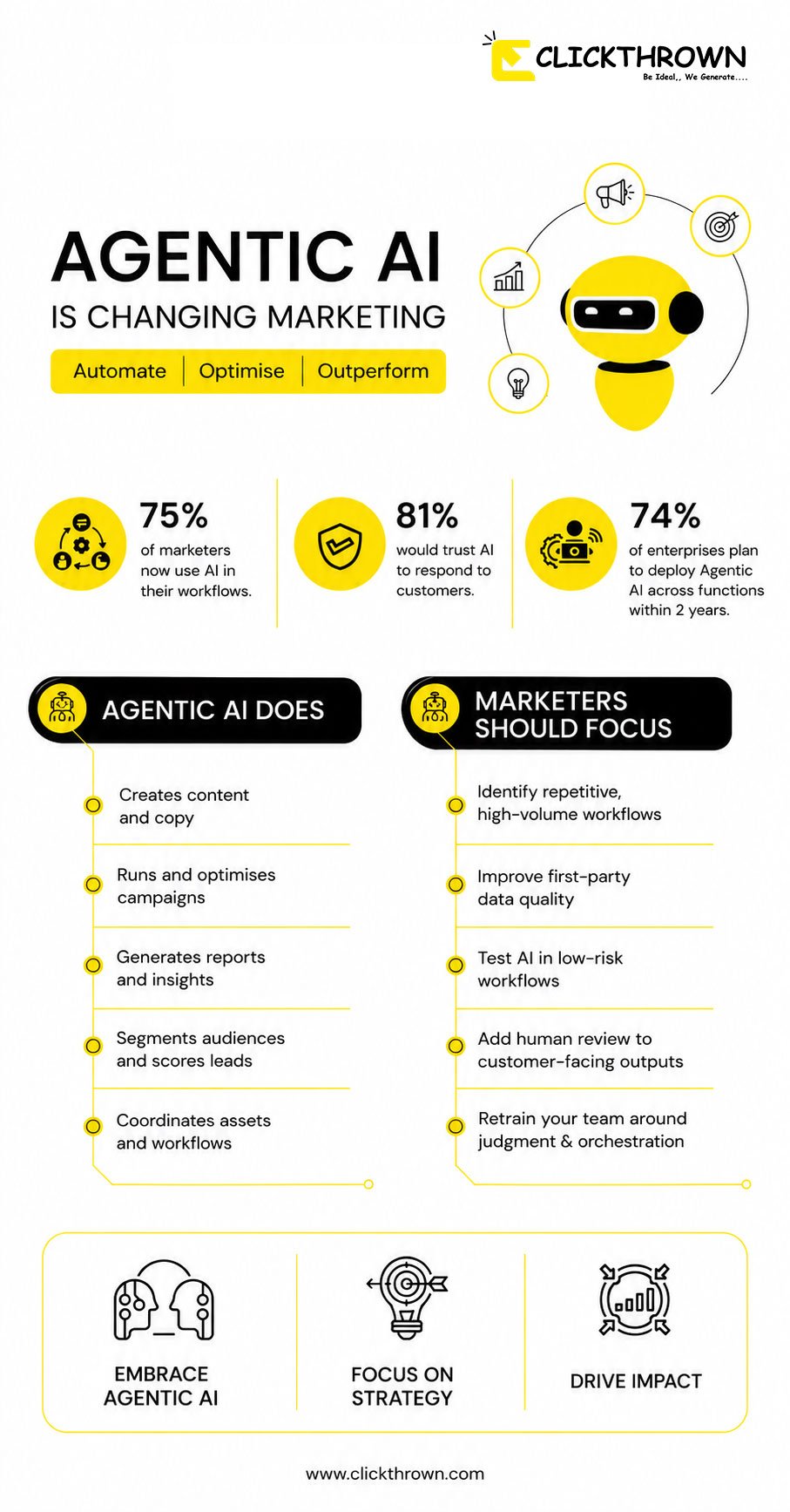
Marketing teams are not disappearing overnight. But marketing work is changing faster than many organisations are prepared for.
The shift is no longer just about using AI to draft blog posts or suggest email subject lines. It is now about agentic AI: systems that can analyse data, decide what to do next, coordinate tasks across tools, and execute parts of a workflow with limited human intervention.
That matters because marketing has always been a function made up of repeatable workflows: research, segmentation, content production, campaign operations, reporting, testing, optimisation, and follow-up. Those are exactly the kinds of activities AI is getting better at every quarter.
Unlocking the power of digital marketing becomes more effective with agentic AI, where intelligent agents continuously learn, adapt, and execute growth strategies across channels.
The question is no longer whether AI will affect marketing jobs. It already has. The real question is:
What should marketing leaders, teams, and individual marketers do now to stay valuable?
|
|
|
|
|
|
|
|
|
|
Agentic AI goes beyond a chatbot or content assistant. Instead of waiting for a human to prompt every step, agentic systems can pursue a goal across multiple steps: gather context, generate options, choose actions, and adapt based on results.
In marketing, that can look like:
Identifying target segments,
Creating campaign variations,
Selecting channels,
Scheduling and launching workflows,
Monitoring performance,
Recommending the next best action,
Updating content or messaging in response to user behaviour.
In simple terms, generative AI is the copilot. Agentic AI is moving toward the operator.
The reasons why agentic AI is transforming marketing in 2026 are:
McKinsey estimates generative AI could add 2.6 trillion to 4.4 trillion annually across 63 business use cases, with roughly 75% of that value concentrated in four areas: customer operations, marketing and sales, software engineering, and R&D.
McKinsey also estimates that generative AI could improve marketing productivity by 5% to 15% of total marketing spend.
That is a major reason boards, CEOs, and CMOs now see AI as a budget, staffing, and growth issue, not just a technology experiment.
Salesforce’s 2024 State of Marketing research found 75% of marketers are either experimenting with or have fully implemented AI, and 63% of marketers using AI say they use generative AI.
HubSpot reported 74% of marketers use at least one AI tool at work, up from 35% the year before.
Stanford’s AI Index reported 55% of organisations were using AI in at least one business unit or function in 2023, while 33% reported using generative AI specifically.
This is no longer early adoption. It is competitive normalisation.
Gartner’s 2024 CMO Spend Survey found average marketing budgets fell to 7.7% of company revenue in 2024, and 64% of CMOs said they lack the budget to fully execute their strategy.
When budgets shrink, companies look for leverage. AI promises exactly that: more output, faster execution, lower production costs, and greater personalisation with the same or smaller teams.
To be precise, AI is not replacing “marketing” as a function. It is replacing specific layers of marketing labour.
One of the clearest use cases is content creation.
HubSpot found marketers using AI save 3 hours per piece of content and 2.5 hours per day overall, while 84% said AI helps them create content more efficiently, and 82% said they are producing significantly more content
McKinsey notes that generative AI can already produce first drafts of:
Ads
Headlines
Product Descriptions
Social Posts
Sales Messages
Personalised Emails At Scale.
What used to require a copywriter, designer, channel manager, and campaign coordinator can increasingly begin with one person directing an AI system.
Agentic AI is especially strong where work is rule-based and repetitive.
Deloitte highlights marketing bottlenecks such as:
Content supply chain reviews
Manual resource allocation
Inefficient asset management
Predictive planning gaps as high-value opportunities for agentic AI.
That means AI is increasingly taking over work such as:
Tagging and organising assets
Routing approvals
Assembling campaign variations
Monitoring performance
Recommending optimisations
These were once coordinator-heavy roles. Now they are prime automation candidates.
AI is also compressing the time needed to pull insights from data.
According to Salesforce, marketers are using AI for:
Performance analytics
Customer segmentation
Automated workflows
Content generation.
AI is helping marketers make data-driven decisions and collaborate across teams more effectively.
Instead of spending hours manually summarising campaign results, marketers can increasingly ask AI to synthesise performance, identify anomalies, suggest segments, and recommend next steps.
Personalisation used to be constrained by team size and time.
Now AI can help produce many variants of:
Emails
Landing pages
Offers
Audience segments
Nurture paths
HubSpot’s State of Marketing Report found 77% of marketers who use gen AI say it helps create more personalised content, and 72% say AI and automation help personalise customer experiences.
This is where agentic AI becomes especially disruptive: not just generating personalised assets, but orchestrating journeys based on behaviour.
When drafting, testing, summarising, segmenting, and optimising get faster, companies naturally ask whether they still need the same number of people to do the same amount of work.
That does not always mean layoffs. It often means:
Smaller teams
Flatter teams
Fewer junior execution roles
More pressure for each marketer to manage systems rather than just outputs.
Generative AI is likely to have the biggest impact on knowledge work, especially activities involving decision-making, communication, documentation, and collaboration.
That includes a large share of modern marketing.
|
AI is not going to replace marketers, but marketers who use AI will replace marketers who don’t.” - Paul Roetzer, Founder, Marketing AI Institute and SmarterX |

AGENTIC AI IS CHANGING MARKETING
Automate, Optimise, Outperform
75% of marketers now use Al in their workflows.
81% would trust Al to respond to customers.
74% of enterprises plan to deploy Agentic Al across functions within 2 years.
AGENTIC AI DOES
Creates content and copy
Runs and optimises campaigns
Generates reports and insights
Segments audiences and scores leads
Coordinates assets and workflows
MARKETERS SHOULD FOCUS
Identify repetitive, high-volume workflows
Improve first-party data quality
Test Al in low-risk workflows
Add human review to customer-facing outputs
Retrain your team around judgment & orchestration
EMBRACE AGENTIC AI. FOCUS ON STRATEGY. DRIVE IMPACT.
Here are some of the most important recent signals:
Generative AI could add 2.6T–4.4T annually to the global economy.
Marketing productivity gains are estimated at 5%–15% of total marketing spend.
75% of marketers are experimenting with or have implemented AI.
74%of marketers use at least one AI tool at work.
55% of organisations use AI in at least one business unit or function.
Generative AI investment reached $25.2 billion in 2023, nearly 9x 2022 levels.
In one Harvard Business School study, GPT-4 improved consultants’ productivity by 12.2%, speed by 25.1%, and quality by 40%.
In an NBER call-centre study cited by Stanford, AI users handled 14.2% more calls per hour.
Gartner found 64% of customers would prefer companies not use AI in customer service, and 53% would consider switching if they found out a company planned to do so.
That last point is critical: AI can improve efficiency, but poor customer-facing execution can destroy trust.
5.What AI Still Cannot Replace Well?
The “AI is replacing marketing teams” headline is directionally true, but incomplete.
AI still struggles with the things that make great marketing truly differentiated:
AI can recombine patterns. It is far less reliable at making a bold strategic call about:
Positioning,
Market timing,
Audience psychology,
Brand tradeoffs.
A model can imitate tone. It cannot fully understand brand nuance, category context, internal politics, or reputational risk the way an experienced marketer can.
Gartner’s customer-service findings show that many customers still want a clear path to a human and remain sceptical of AI-led experiences.
That means brand trust, relationship-building, community leadership, and high-stakes communication still require people.
Someone still has to own:
Accuracy
Compliance
Ethics
Bias review
Approval workflows
Crisis response.
In fact, as AI spreads, governance becomes more important, not less.
The major risks of over-relying on Agentic AI in marketing are:
If every team uses the same models to create the same formats from the same prompts, content quality may rise while distinctiveness falls.
Salesforce found that only 31% of marketers are fully satisfied with their ability to unify customer data sources.
If your data is fragmented, your AI will automate confusion.
If AI creates friction in customer interactions, the savings can be offset by churn.
By the end of 2026, 60% of CMOs will adopt technologies to protect their brands from GenAI-driven deception.
That tells you the next marketing battleground is not just efficiency. It is authenticity and trust.
Key strategies for Digital Marketing success in the era of agentic AI focus on autonomous systems optimising campaigns, targeting, and decision-making in real time.
Here is the AI readiness of marketing teams by country in 2026.
The steps marketing leaders should take to stay ahead in the competition are:
The marketers who thrive will not be the ones who produce the most drafts manually. They will be the ones who can:
Direct AI,
Evaluate Outputs,
Improve Workflows,
Make Strategic Decisions From AI-Assisted Insights.
That means role design should shift from:
Writer → content strategist/editor
Analyst → insight interpreter
Campaign manager → orchestration lead
Coordinator → automation operator.
Start with the highest-friction, highest-volume work:
Content repurposing
Campaign QA
Lead routing
Asset tagging
Reporting summaries
Nurture sequence branching
Customer journey optimisation
The practical advice is to first establish where friction lives, then embed agentic AI in those workflows, then elevate humans into more strategic work.
AI only works well when the context is strong.
Data unification remains a major barrier, and HubSpot’s broader research consistently ties AI effectiveness to integrated systems and shared data.
In HubSpot, that means getting serious about:
CRM hygiene
Lifecycle stages
Segmentation
Contact properties
Behaviour data
Connected reporting
Without that, you are not building agentic marketing. You are just generating text faster.
Use AI for scale. Use people for trust.
A good rule:
AI drafts
AI suggests
AI routes
AI analyses
But humans approve high-impact customer outputs and customer escalations.
This is especially important for pricing, service recovery, brand messaging, sensitive industries, and executive communications.
Measure AI by business outcomes by tracking the following:
Time to launch,
Asset production cost,
Throughput,
Response rate,
Conversion rate,
Customer retention,
Analyst hours saved,
Lift from personalisation.
McKinsey found 42% of organisations reported cost reductions from AI adoption and 59% reported revenue increases.
That is the benchmark mindset: operational improvement tied to revenue and cost, not just experimentation.
If AI is replacing task-based labour, the surviving skill set looks different:
Strategic Thinking
Prompt Design
Workflow Design
Experimentation
QA and Compliance
Analytics Interpretation
Stakeholder Communication
The safest marketers will be the ones who become exceptionally good at directing systems and interpreting outcomes.
Unlocking the power of digital marketing becomes more effective with agentic AI, where intelligent agents continuously learn, adapt, and execute growth strategies across channels.
The likely future is “no marketing team.”
It is going to be all about:
Smaller execution teams,
More AI-enabled specialists,
Faster campaign cycles,
More content variants,
More pressure on brand consistency,
Greater value is placed on strategy, creativity, governance, and customer trust.
In other words, AI will replace a lot of marketing labour, but the marketers who understand markets, people, and systems will become more valuable, not less.
The ultimate beginner's guide to performance marketing now includes agentic AI tools that automate bidding, personalise ads, and improve ROI with minimal manual intervention.
Agentic AI is replacing parts of marketing teams because those parts were built on repeatable workflows, manual coordination, and high-volume production.
The evidence is already clear:
Adoption is widespread,
Productivity gains are real,
Budgets are pressuring leaders to do more with less,
The next phase is workflow-level autonomy, not just content assistance.
The winners will not be the teams that resist AI.
They will be the teams that:
Automate the repetitive,
Protect the human,
Strengthen their data foundation,
Redesign roles around judgment,
Use AI to make marketing more relevant, more responsive, and more trustworthy.
That is not the end of marketing teams.
It is the end of marketing teams built for a pre-agentic era.
1.Will agentic AI replace marketers completely?
No. It is more likely to replace tasks and role layers than the entire function. AI is strongest at repeatable production, structured analysis, and workflow execution. Humans still matter most for strategy, creativity, governance, and trust.
2.Which marketing jobs are most at risk from agentic AI?
The marketing tasks most vulnerable to automation include basic content drafting, repetitive campaign operations, routine reporting, asset production coordination, and lower-level segmentation and workflow management.
3.What skills will make marketers more valuable in the AI era?
The most valuable skills in the age of Agentic AI will be strategic thinking, systems design, AI workflow management, audience insight interpretation, creative direction, and governance.
4.Is AI in marketing actually delivering ROI?
Yes. McKinsey reports 42% of organisations using AI reported cost reductions and 59% reported revenue increases. HubSpot and Salesforce also report widespread gains in efficiency, personalisation, and execution speed.
5.What should a marketing leader do first?
Marketing leaders should begin by identifying repetitive, high-volume workflows, improving first-party data quality, testing AI in low-risk use cases, adding human review to customer-facing outputs, and retraining their teams to focus on strategic judgement and AI orchestration.
6.How can marketers future-proof their careers in the age of Agentic AI?
Marketers can stay relevant by developing skills in strategic thinking, AI workflow management, data interpretation, creative direction, and governance. Professionals who can guide AI systems and turn insights into business decisions will remain in high demand.
Related Articles
Google Ads vs Meta Ads: Which Platform Delivers Better ROI
Is Your Business in Kochi Invisible on Google? Fix It with Local SEO
10 Digital Marketing Mistakes That Are Killing Your Website Traffic
Some awesome words from awesome people
Clickthrown provides advanced digital marketing services, including social media management, SEO optimization, pay-per-click (PPC) marketing, content creation, and innovative digital campaigns such as augmented reality and interactive experiences. Their services are data-driven and tailored to each business’s unique needs.
They are located in Kochi, Kerala, specifically at Fourth Floor, Manghat Arcade, Kaloor Kadavanthra Road, Ernakulam, Kerala, India.
Clickthrown emphasizes creating captivating visuals combined with strategic digital marketing to elevate brands. They focus on innovative solutions that exceed expectations and use data analytics to optimize marketing strategies. Their team includes digital marketing strategists, creatives, and data analysts passionate about unlocking business growth potential.
Yes, Clickthrown Digital Private Limited is a registered private company in Ernakulam.
Clickthrown Digital Private Limited is a leading performance marketing agency in Kochi, Kerala, India. Our passionate team of digital marketing strategists, writers, creatives, and data analysts is dedicated to helping businesses unlock their full growth potential. We offer a comprehensive suite of services, including Strategic Digital Marketing Planning & Execution, Creative Content Marketing, Social Media Management, Search Engine Optimization (SEO), Pay-Per-Click (PPC) Advertising, Website Design & Development, and Data Analytics & Performance Reporting.
We have served clients in various sectors such as Edtech, Healthcare, and IT in both India and Dubai. As the best Digital Marketing Agency in Kochi, we believe in building long-term partnerships with our clients by providing personalized solutions that drive real results. Our team of digital marketing experts has years of experience leveraging the power of captivating visuals and strategic digital marketing to elevate brands. Our creative professionals and digital experts work collaboratively to deliver innovative solutions that not only meet but exceed expectations.
At Clickthrown, we develop marketing strategies that help businesses thrive in the social media domain and boost their overall productivity in lead generation, increase virtual traffic, and practice social niche domination. With our dedicated team personnel, tending to different departments of digital marketing, we take care of each of your business needs in detail. Our crisp creative ideas and concepts are sure to boost your business sales and revenue and help you succeed. With a focus on creating impactful and engaging digital experiences, Clickthrown is all set to help your brand stand out and achieve lasting success.