
Quick Answer
Agentic AI is replacing marketing teams by automating key marketing functions like campaign planning, content creation, targeting, and performance optimisation, reducing the need for large execution-heavy teams.
Marketers should shift toward strategy, creativity, and AI supervision, focusing on guiding AI systems, interpreting insights, and driving brand-level decisions.
Marketing teams are not disappearing overnight. But marketing work is changing faster than many organisations are prepared for.
The shift is no longer just about using AI to draft blog posts or suggest email subject lines. It is now about agentic AI: systems that can analyse data, decide what to do next, coordinate tasks across tools, and execute parts of a workflow with limited human intervention.
That matters because marketing has always been a function made up of repeatable workflows: research, segmentation, content production, campaign operations, reporting, testing, optimisation, and follow-up. Those are exactly the kinds of activities AI is getting better at every quarter.
Unlocking the power of digital marketing becomes more effective with agentic AI, where intelligent agents continuously learn, adapt, and execute growth strategies across channels.
The question is no longer whether AI will affect marketing jobs. It already has. The real question is: What should marketing leaders, teams, and individual marketers do now to stay valuable?
Agentic AI goes beyond a chatbot or content assistant. Instead of waiting for a human to prompt every step, agentic systems can pursue a goal across multiple steps: gather context, generate options, choose actions, and adapt based on results.
In marketing, that can look like:
Identifying target segments,
Creating campaign variations,
Selecting channels,
Scheduling and launching workflows,
Monitoring performance,
Recommending the next best action,
Updating content or messaging in response to user behaviour.
In simple terms, generative AI is the copilot. Agentic AI is moving toward the operator.
The reasons why agentic AI is transforming marketing in 2026 are:
2.1 Marketing is one of the functions most exposed to AI
McKinsey estimates generative AI could add 2.6 trillion to 4.4 trillion annually across 63 business use cases, with roughly 75% of that value concentrated in four areas: customer operations, marketing and sales, software engineering, and R&D.
McKinsey also estimates that generative AI could improve marketing productivity by 5% to 15% of total marketing spend.
That is a major reason boards, CEOs, and CMOs now see AI as a budget, staffing, and growth issue, not just a technology experiment.
Salesforce’s 2024 State of Marketing research found 75% of marketers are either experimenting with or have fully implemented AI, and 63% of marketers using AI say they use generative AI.
HubSpot reported 74% of marketers use at least one AI tool at work, up from 35% the year before.
Stanford’s AI Index reported 55% of organisations were using AI in at least one business unit or function in 2023, while 33% reported using generative AI specifically.
This is no longer early adoption. It is competitive normalisation.
Gartner’s 2024 CMO Spend Survey found average marketing budgets fell to 7.7% of company revenue in 2024, and 64% of CMOs said they lack the budget to fully execute their strategy.
When budgets shrink, companies look for leverage. AI promises exactly that: more output, faster execution, lower production costs, and greater personalisation with the same or smaller teams.
To be precise, AI is not replacing “marketing” as a function. It is replacing specific layers of marketing labour.
One of the clearest use cases is content creation.
HubSpot found marketers using AI save 3 hours per piece of content and 2.5 hours per day overall, while 84% said AI helps them create content more efficiently, and 82% said they are producing significantly more content
McKinsey notes that generative AI can already produce first drafts of:
Ads
Headlines
Product Descriptions
Social Posts
Sales Messages
Personalised Emails At Scale.
What used to require a copywriter, designer, channel manager, and campaign coordinator can increasingly begin with one person directing an AI system.
Agentic AI is especially strong where work is rule-based and repetitive.
Deloitte highlights marketing bottlenecks such as:
Content supply chain reviews
Manual resource allocation
Inefficient asset management
Predictive planning gaps as high-value opportunities for agentic AI.
That means AI is increasingly taking over work such as:
Tagging and organising assets
Routing approvals
Assembling campaign variations
Monitoring performance
Recommending optimisations
These were once coordinator-heavy roles. Now they are prime automation candidates.
AI is also compressing the time needed to pull insights from data.
According to Salesforce, marketers are using AI for:
Performance analytics
Customer segmentation
Automated workflows
Content generation.
AI is helping marketers make data-driven decisions and collaborate across teams more effectively.
Instead of spending hours manually summarising campaign results, marketers can increasingly ask AI to synthesise performance, identify anomalies, suggest segments, and recommend next steps.
Personalisation used to be constrained by team size and time.
Now AI can help produce many variants of:
Emails
Landing pages
Offers
Audience segments
Nurture paths
HubSpot’s State of Marketing Report found 77% of marketers who use gen AI say it helps create more personalised content, and 72% say AI and automation help personalise customer experiences.
This is where agentic AI becomes especially disruptive: not just generating personalised assets, but orchestrating journeys based on behaviour.
When drafting, testing, summarising, segmenting, and optimising get faster, companies naturally ask whether they still need the same number of people to do the same amount of work.
That does not always mean layoffs. It often means:
Smaller teams
Flatter teams
Fewer junior execution roles
More pressure for each marketer to manage systems rather than just outputs.
Generative AI is likely to have the biggest impact on knowledge work, especially activities involving decision-making, communication, documentation, and collaboration.
That includes a large share of modern marketing.
|
AI is not going to replace marketers, but marketers who use AI will replace marketers who don’t.” - Paul Roetzer, Founder, Marketing AI Institute and SmarterX |
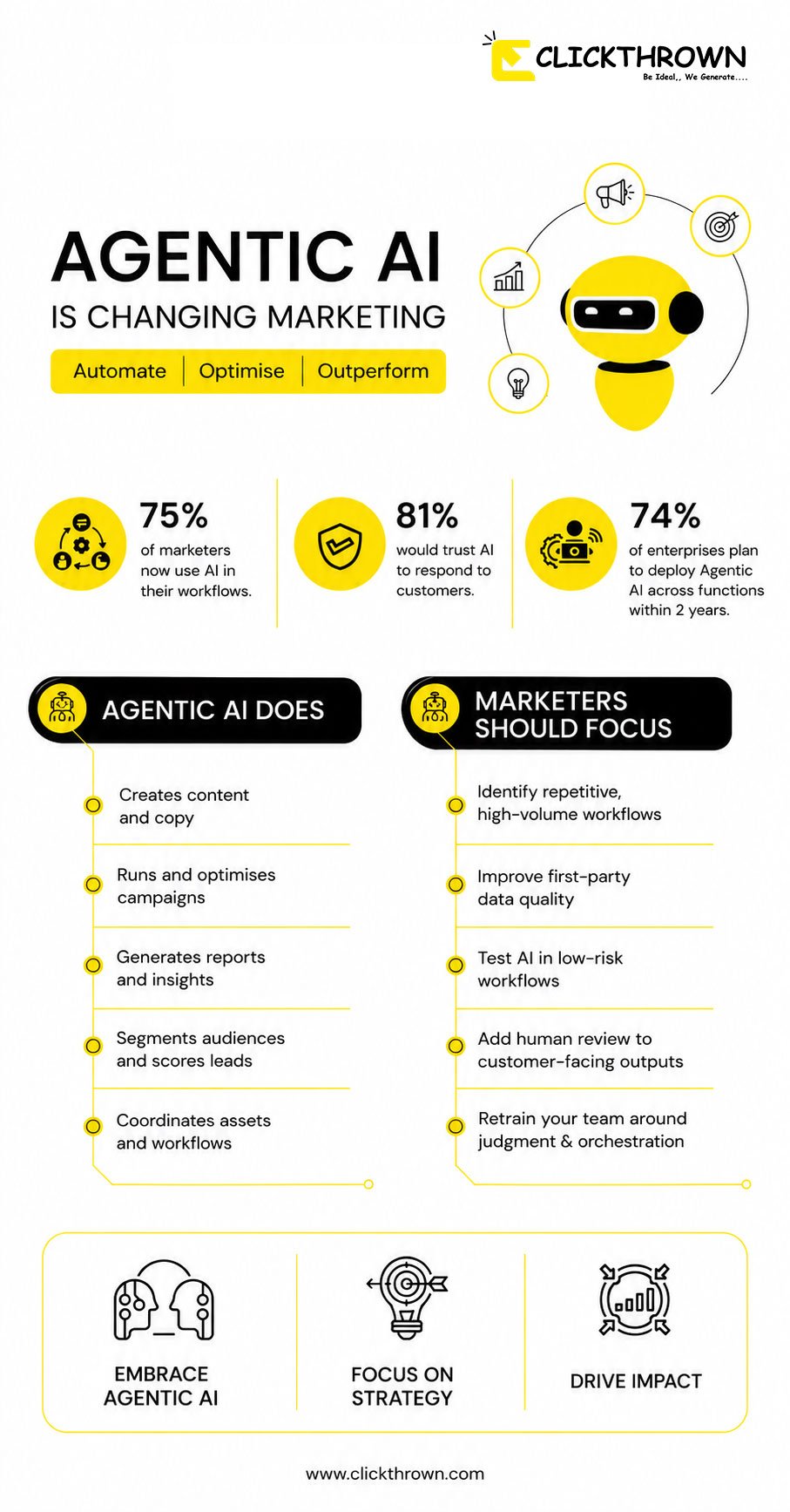
AGENTIC AI IS CHANGING MARKETING
Automate, Optimise, Outperform
75% of marketers now use Al in their workflows.
81% would trust Al to respond to customers.
74% of enterprises plan to deploy Agentic Al across functions within 2 years.
AGENTIC AI DOES
Creates content and copy
Runs and optimises campaigns
Generates reports and insights
Segments audiences and scores leads
Coordinates assets and workflows
MARKETERS SHOULD FOCUS
Identify repetitive, high-volume workflows
Improve first-party data quality
Test Al in low-risk workflows
Add human review to customer-facing outputs
Retrain your team around judgment & orchestration
EMBRACE AGENTIC AI. FOCUS ON STRATEGY. DRIVE IMPACT.
Here are some of the most important recent signals:
Generative AI could add 2.6T–4.4T annually to the global economy.
Marketing productivity gains are estimated at 5%–15% of total marketing spend.
75% of marketers are experimenting with or have implemented AI.
74%of marketers use at least one AI tool at work.
55% of organisations use AI in at least one business unit or function.
Generative AI investment reached $25.2 billion in 2023, nearly 9x 2022 levels.
In one Harvard Business School study, GPT-4 improved consultants’ productivity by 12.2%, speed by 25.1%, and quality by 40%.
In an NBER call-centre study cited by Stanford, AI users handled 14.2% more calls per hour.
Gartner found 64% of customers would prefer companies not use AI in customer service, and 53% would consider switching if they found out a company planned to do so.
That last point is critical: AI can improve efficiency, but poor customer-facing execution can destroy trust.
The “AI is replacing marketing teams” headline is directionally true, but incomplete.
AI still struggles with the things that make great marketing truly differentiated:
AI can recombine patterns. It is far less reliable at making a bold strategic call about:
Positioning,
Market timing,
Audience psychology,
Brand tradeoffs.
A model can imitate tone. It cannot fully understand brand nuance, category context, internal politics, or reputational risk the way an experienced marketer can.
Gartner’s customer-service findings show that many customers still want a clear path to a human and remain sceptical of AI-led experiences.
That means brand trust, relationship-building, community leadership, and high-stakes communication still require people.
Someone still has to own:
Accuracy
Compliance
Ethics
Bias review
Approval workflows
Crisis response.
In fact, as AI spreads, governance becomes more important, not less.
The major risks of over-relying on Agentic AI in marketing are:
If every team uses the same models to create the same formats from the same prompts, content quality may rise while distinctiveness falls.
Salesforce found that only 31% of marketers are fully satisfied with their ability to unify customer data sources.
If your data is fragmented, your AI will automate confusion.
If AI creates friction in customer interactions, the savings can be offset by churn.
By the end of 2026, 60% of CMOs will adopt technologies to protect their brands from GenAI-driven deception.
That tells you the next marketing battleground is not just efficiency. It is authenticity and trust.
Key strategies for Digital Marketing success in the era of agentic AI focus on autonomous systems optimising campaigns, targeting, and decision-making in real time.
Here is the AI readiness of marketing teams by country in 2026.
The steps marketing leaders should take to stay ahead in the competition are:
The marketers who thrive will not be the ones who produce the most drafts manually. They will be the ones who can:
Direct AI,
Evaluate Outputs,
Improve Workflows,
Make Strategic Decisions From AI-Assisted Insights.
That means role design should shift from:
Writer → content strategist/editor
Analyst → insight interpreter
Campaign manager → orchestration lead
Coordinator → automation operator.
Start with the highest-friction, highest-volume work:
Content repurposing
Campaign QA
Lead routing
Asset tagging
Reporting summaries
Nurture sequence branching
Customer journey optimisation
The practical advice is to first establish where friction lives, then embed agentic AI in those workflows, then elevate humans into more strategic work.
AI only works well when the context is strong.
Data unification remains a major barrier, and HubSpot’s broader research consistently ties AI effectiveness to integrated systems and shared data.
In HubSpot, that means getting serious about:
CRM hygiene
Lifecycle stages
Segmentation
Contact properties
Behaviour data
Connected reporting
Without that, you are not building agentic marketing. You are just generating text faster.
Use AI for scale. Use people for trust.
A good rule:
AI drafts
AI suggests
AI routes
AI analyses
But humans approve high-impact customer outputs and customer escalations.
This is especially important for pricing, service recovery, brand messaging, sensitive industries, and executive communications.
Measure AI by business outcomes by tracking the following:
Time to launch,
Asset production cost,
Throughput,
Response rate,
Conversion rate,
Customer retention,
Analyst hours saved,
Lift from personalisation.
McKinsey found 42% of organisations reported cost reductions from AI adoption and 59% reported revenue increases.
That is the benchmark mindset: operational improvement tied to revenue and cost, not just experimentation.
If AI is replacing task-based labour, the surviving skill set looks different:
Strategic Thinking
Prompt Design
Workflow Design
Experimentation
QA and Compliance
Analytics Interpretation
Stakeholder Communication
The safest marketers will be the ones who become exceptionally good at directing systems and interpreting outcomes.
Unlocking the power of digital marketing becomes more effective with agentic AI, where intelligent agents continuously learn, adapt, and execute growth strategies across channels.
The likely future is “no marketing team.”
It is going to be all about:
Smaller execution teams,
More AI-enabled specialists,
Faster campaign cycles,
More content variants,
More pressure on brand consistency,
Greater value is placed on strategy, creativity, governance, and customer trust.
In other words, AI will replace a lot of marketing labour, but the marketers who understand markets, people, and systems will become more valuable, not less.
The ultimate beginner's guide to performance marketing now includes agentic AI tools that automate bidding, personalise ads, and improve ROI with minimal manual intervention.
Agentic AI is replacing parts of marketing teams because those parts were built on repeatable workflows, manual coordination, and high-volume production.
The evidence is already clear:
Adoption is widespread,
Productivity gains are real,
Budgets are pressuring leaders to do more with less,
The next phase is workflow-level autonomy, not just content assistance.
The winners will not be the teams that resist AI.
They will be the teams that:
Automate the repetitive,
Protect the human,
Strengthen their data foundation,
Redesign roles around judgment,
Use AI to make marketing more relevant, more responsive, and more trustworthy.
That is not the end of marketing teams.
It is the end of marketing teams built for a pre-agentic era.
Related Articles
Google Ads vs Meta Ads: Which Platform Delivers Better ROI
Is Your Business in Kochi Invisible on Google? Fix It with Local SEO
10 Digital Marketing Mistakes That Are Killing Your Website Traffic





.webp)